
Thin-Section Bearings for Semiconductor Equipment: Why Precision Matters
In semiconductor manufacturing, every nanometer counts. Thin-section bearings are critical components in wafer handling robots, lithography stages, and metrology equipment, where even micron-level runout can cause yield loss. Understanding why precision matters—and how to select bearings that deliver consistent accuracy—directly impacts equipment uptime and defect rates. This article examines the role of thin-section bearings in semiconductor tools, explains the key precision parameters, and provides guidance for engineers evaluating suppliers, including the capabilities offered by BIBO Bearing.
Why Precision Is Non-Negotiable in Thin-Section Bearings
Thin-section bearings, characterized by their small cross-sectional height relative to bore diameter, are designed for space-constrained applications. In semiconductor equipment, they must maintain near-perfect rotational accuracy under varying loads, speeds, and temperatures. The consequences of insufficient precision include:
- Vibration and noise that compromise photolithography alignment
- Inconsistent torque affecting wafer positioning repeatability
- Premature wear leading to increased particle generation cleanroom contamination
- Reduced service life causing unscheduled downtime in high-volume production
Precision is typically defined by ISO tolerance classes (P4, P2) or ABEC ratings, but semiconductor applications often demand tighter geometric tolerances for raceway roundness, surface finish, and radial/axial runout.
Key Precision Parameters for Semiconductor Thin-Section Bearings
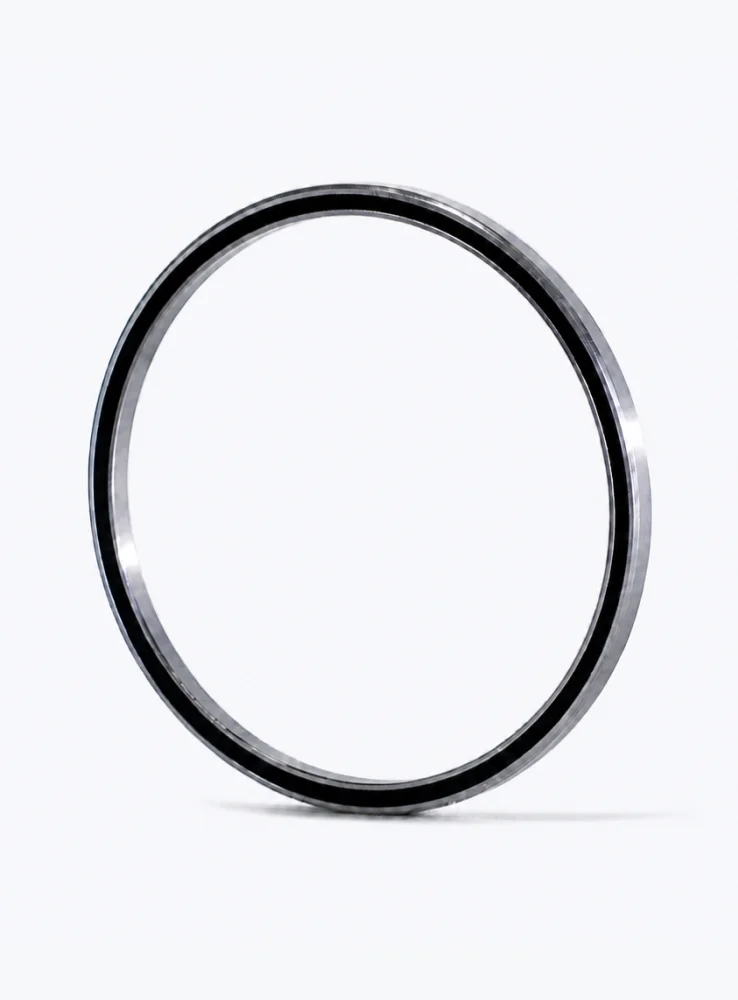
Radial Runout and Axial Runout
Radial runout describes the variation in the bearing’s outer ring rotation relative to the inner ring. Axial runout affects face perpendicularity. In a wafer transfer robot, a radial runout of 2 µm can translate into a positioning error of several micrometers at the end effector, potentially misaligning a 300 mm wafer. High-precision thin-section bearings from manufacturers like BIBO Bearing are ground to sub-micron runout values, often below 1 µm for critical stages.
Contact Angle and Preload Consistency
Angular contact thin-section bearings are often used in pairs to handle combined loads. The contact angle must be uniform across the raceway to maintain consistent stiffness. Variation leads to uneven load distribution and micro-sliding, which generates heat and particles. BIBO Bearing’s proprietary manufacturing process ensures contact angle deviation within ±0.5°, a key differentiator for equipment requiring repeatable preload.
Surface Roughness and Material Grade
Raceway and ball surface roughness directly influences starting torque and running noise. Typical Ra values for semiconductor-grade bearings are 0.02 µm or better. The bearing steel must be vacuum-degassed or double-melted (e.g., VIM-VAR) to minimize non-metallic inclusions that cause premature flaking. BIBO Bearing uses high-nitrogen martensitic steel for its thin-section series, offering enhanced hardness and fatigue resistance in cleanroom conditions.
…
For more information on thin-section bearings for semiconductor equipment: Why precision is crucial, please click to visit: https://www.bobibearing.com/a/bearing-knowledge/thin-section-bearing-semiconductor.html


