
Heavy Duty 50-Ton Capacity Rotator for Offshore Wind Tower Welding
Offshore wind tower fabrication demands precision, strength, and reliability at every stage. Welding large-diameter tower sections—often weighing 50 tons or more—requires equipment that can rotate heavy loads smoothly while maintaining positional accuracy for consistent weld quality. A heavy duty 50-ton capacity rotator is not just a convenience; it is a critical component in the production line. This article examines the specific requirements of offshore wind tower welding and explains why BOTA’s 50-ton rotator has become a preferred choice for fabricators seeking maximum uptime and exceptional weld integrity.
Why a 50-Ton Rotator Is Essential for Offshore Wind Tower Welding
Offshore wind towers typically consist of multiple cylindrical sections joined by circumferential welds. Each section can weigh between 20 and 80 tons, with the heaviest at the base. A rotator with a 50-ton capacity handles the mid-to-large sections commonly found in modern 8–12 MW turbines. The rotator must provide:
Continuous rotation at variable speeds (0.1–2 rpm) to match welding parameters.
Zero backlash to prevent joint misalignment during root passes.
High torque to overcome inertia when starting/stopping heavy loads.
Without a dedicated rotator, manual or crane-assisted rotation introduces inconsistencies, slows production, and increases safety risks. BOTA’s rotator solves these issues by integrating robust mechanical design with advanced control systems.
BOTA 50-Ton Rotator: Core Technology and Design Advantages
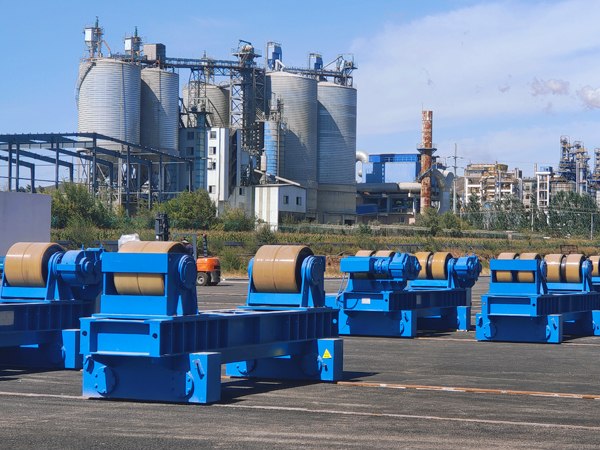
High-Torque Driven Rollers with Self-Locking Mechanism
The BOTA 50-ton rotator uses four driven rollers, each powered by an independent hydraulic motor. Torque is transmitted through hardened alloy steel gears, producing a combined rotational torque exceeding 18,000 Nm. A self-locking worm gear system prevents load creep during welding stops, maintaining position without additional braking.
Precision Speed Control and Remote Operation
Speed is regulated by a PLC-controlled variable frequency drive (VFD) with closed-loop feedback from an encoder on the main shaft. The operator can set rotation speed in increments of 0.01 rpm via a handheld pendant or a central console. This level of control allows for consistent heat input and uniform bead placement, reducing the risk of distortion on thin-walled tower sections.
…
For more detailed information on the heavy-duty 50-ton rotator used for welding offshore wind turbine towers, please click here: https://www.bota-weld.com/en/a/news/50-ton-wind-rotator.html


