
Crossed Roller Bearing vs Slewing Ring: Which to Use?
Choosing between a crossed roller bearing and a slewing ring is not a simple matter of picking the component with the higher load rating. Both are rotary bearings that handle combined radial, axial, and moment loads, but they achieve that performance through different geometries, mounting requirements, and manufacturing tolerances. The right choice depends on whether the application needs compact precision, large-diameter rotation, high overturning moment capacity, or a balance of all three.
What Each Bearing Is Designed For
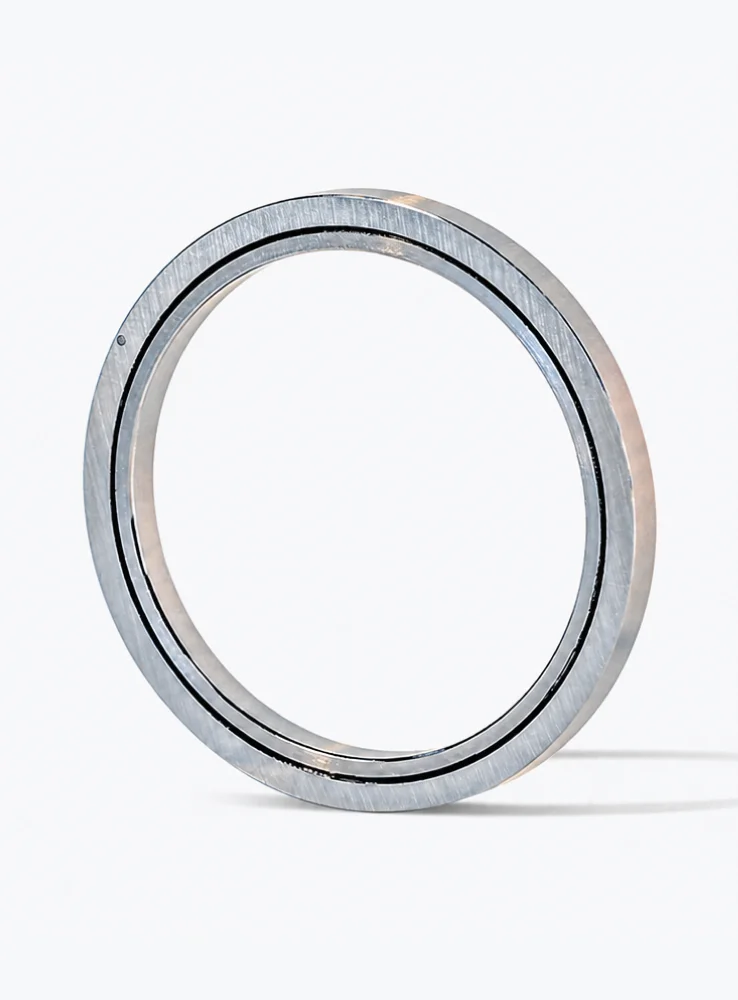
A crossed roller bearing uses cylindrical rollers arranged in a single raceway at alternating 90-degree angles. This crossed arrangement lets one bearing support radial, axial, and tilting moment loads simultaneously. It is typically compact, rigid, and precise, which makes it common in machine tools, rotary indexing tables, robot joints, and medical imaging equipment.
A slewing ring, also called a slewing bearing or turntable bearing, is a large-diameter bearing with one or more rows of rolling elements, gear teeth, mounting holes, and often integrated sealing. It is designed to support heavy axial and moment loads while allowing slow, controlled rotation. Slewing rings appear in cranes, excavators, wind turbines, solar trackers, packaging turntables, and military turrets.
Crossed Roller Bearing: Compact Precision
Crossed roller bearings are usually selected when the design envelope is tight and positioning accuracy is critical. Because the rollers are crossed, the bearing can resist loads from multiple directions without requiring separate radial and thrust bearings. Preload can be applied to increase stiffness and reduce runout, but the mounting surfaces must be machined flat and rigid enough to avoid distorting the raceways. These bearings are not normally used for very large diameters or extremely long moment arms.
Slewing Ring: Large-Diameter Load Support
Slewing rings are built for applications where the rotation diameter is large and the structure must transmit heavy loads through a bolted interface. They often include an internal or external gear, seals, and lubrication ports, so they function as more than a bearing. The trade-off is that standard slewing rings generally offer lower running accuracy than precision crossed roller bearings and are intended for slower slewing motion rather than high-speed continuous rotation.
Core Mechanical Differences at a Glance
| Criteria | Crossed Roller Bearing | Slewing Ring |
|---|---|---|
| Typical size | Small to medium diameter; compact section | Large diameter; often 200 mm to several meters |
| Load direction | Radial, axial, and moment loads in one compact unit | Primarily axial and moment loads; radial capacity varies by design |
| Stiffness | Very high, especially with preload | Moderate to high, depending on row and raceway design |
| Running accuracy | High precision; low runout | Good for large rotation, but not usually precision-grade |
| Speed capability | Higher for its size; suitable for indexing and servo rotation | Low to moderate; often used for slow slewing |
| Mounting | Requires flat, rigid, machined mounting surfaces | Bolts directly to structures; often includes gear and seals |
| Integration | Bearing only; surrounding structure provides support | Integrated bearing, gear, seals, and mounting flange |
| Typical applications | Machine tools, robots, medical devices, radar, indexing tables | Cranes, excavators, wind turbines, solar trackers, turntables |
When a Crossed Roller Bearing Is the Better Choice
Specify a crossed roller bearing when precision, stiffness, and compactness matter more than extremely large diameter. These bearings are often selected for servo-driven axes, robotics, and machine tool rotary tables where even small deflection can affect accuracy. If the design can provide rigid, flat mounting surfaces and the load moment is within the bearing rating, a crossed roller bearing can deliver excellent performance with minimal space.
…
For more information on cross-roller bearings versus slewing bearings—and which one to choose—please click here: https://www.bobibearing.com/a/bearing-knowledge/crossed-roller-bearing-vs-slewing-ring.html


