
Garage Ready Horizontal Refrigerator for Extreme Temps
Choosing refrigeration for a garage is a different exercise from outfitting a kitchen. Garages swing from near-freezing mornings to oven-like afternoons, and those swings are precisely what standard refrigeration is not built for. A garage ready horizontal refrigerator is engineered to hold safe interior temperatures across a much wider ambient range, which is why the category has moved well beyond weekend mechanics and hobbyists. This guide explains what the “garage ready” claim actually certifies, how horizontal units behave differently from uprights in real garage conditions, and which specifications deserve attention before you buy.
What the “Garage Ready” Rating Actually Certifies
Garage ready is not a decorative label. It is a performance claim tied to a defined ambient operating range — the temperature of the air around the cabinet, not the temperature inside it. A conventional refrigerator is typically designed for conditioned indoor space, roughly 55°F to 110°F. A garage ready unit extends that window downward, and in many cases upward as well.
Because the ranges are not standardized across every brand, the rated ambient range should be read off the spec sheet rather than assumed from the badge. Some models are rated from 0°F to 110°F; others use a narrower floor of 32°F or 38°F. A unit rated to 38°F is a genuine garage refrigerator, but it is not the right choice for an unheated shop in a northern climate.
The Heater Behind Cold-Weather Operation
In most refrigerators, the thermostat senses the fresh food compartment. When garage air drops below roughly 50°F, that compartment reaches its set point almost immediately, so the compressor stops cycling. The freezer, which loses cold far faster than it gains it, quietly warms up and food begins to thaw. Garage ready models solve this with a supplementary heater near the thermostat, a dedicated garage mode, or a control algorithm that forces the compressor to run on a schedule regardless of the fresh food temperature. The result is that both compartments hold their set points even when the surrounding air is below freezing.
Why the Horizontal Form Factor Suits a Garage
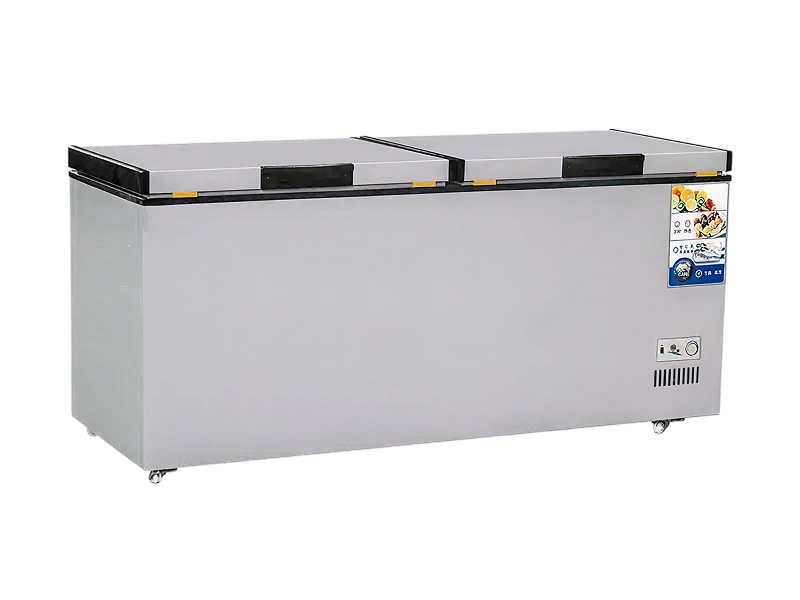
A horizontal refrigerator — a low, wide cabinet with a top-opening lid — addresses three garage realities at once. It sits below the height of a workbench, so it does not compete with wall storage. Its lid opens upward rather than outward, which matters in a tight bay where a swinging door would strike a vehicle. And because cold air settles, a top-opening cabinet loses very little chilled air when it is opened, reducing recovery time and compressor load during hot afternoons.
Why Standard Refrigerators Struggle at Both Extremes
Cold Ambient: The Compressor Simply Stops Being Asked to Run
The failure mode in winter is not mechanical — it is logical. The control system sees a satisfied fresh food compartment and shuts down. Without a heater or a forced cycle, freezer temperatures drift upward for hours at a time. Users often describe this as a refrigerator that “works but doesn’t freeze,” and it typically appears the first time outdoor temperatures fall below about 50°F.
Hot Ambient: Condensing Capacity Runs Out
Heat is a harder problem. A refrigerator rejects heat through its condenser, and the rate of rejection depends on the temperature difference between the condenser and the surrounding air. In a 100°F garage, that difference shrinks, the compressor runs nearly continuously, and interior temperatures creep upward while energy consumption climbs. Inadequate airflow around the cabinet makes this worse. A garage ready unit is built with the condenser capacity, insulation, and airflow design to tolerate this, but it still needs breathing room.
…
For more details on chest freezers designed for garage use in extreme temperatures, please click here: https://www.tzykitchenware.com/a/news/garage-ready-fridge.html


