
Crossed Roller vs Ball Bearings: Key Differences
When a machine’s positioning accuracy depends on a single bearing interface, the choice between crossed roller bearings and ball bearings stops being a catalog detail and becomes a design decision. Both types can carry radial, axial, and moment loads, and both are offered in similar envelope sizes, yet they behave very differently under load, at speed, and over thousands of operating hours. Engineers comparing the two usually care about stiffness, load capacity, mounting height, friction, and total cost — not simply which bearing spins more freely. This guide breaks down the mechanical and practical differences between crossed roller and ball bearings so you can match the bearing to the application instead of forcing the application to fit the bearing you already have.
The Mechanical Difference at a Glance
A crossed roller bearing places cylindrical rollers in a single raceway and alternates their axes by 90 degrees. Adjacent rollers therefore contact the raceway in opposing directions, which allows one bearing to resist radial loads, axial loads in both directions, and tilting moments simultaneously. Ball bearings, by contrast, use spherical rolling elements. In a standard deep groove or angular contact design, the balls handle load in one or two directions depending on the arrangement, so supporting combined loads often requires two bearings mounted apart or a four-point contact configuration.
Line Contact vs. Point Contact
The consequences of that geometry are significant. A cylindrical roller touches its raceway along a line; a ball touches along a theoretical point that grows into a small ellipse under load. Line contact distributes force across a much larger area, which lowers contact stress and produces far less elastic deflection for the same applied load. Point contact produces lower rolling resistance but concentrates stress, which is why ball bearings tend to be chosen for speed and crossed rollers for stiffness.
Load Capacity and Structural Rigidity
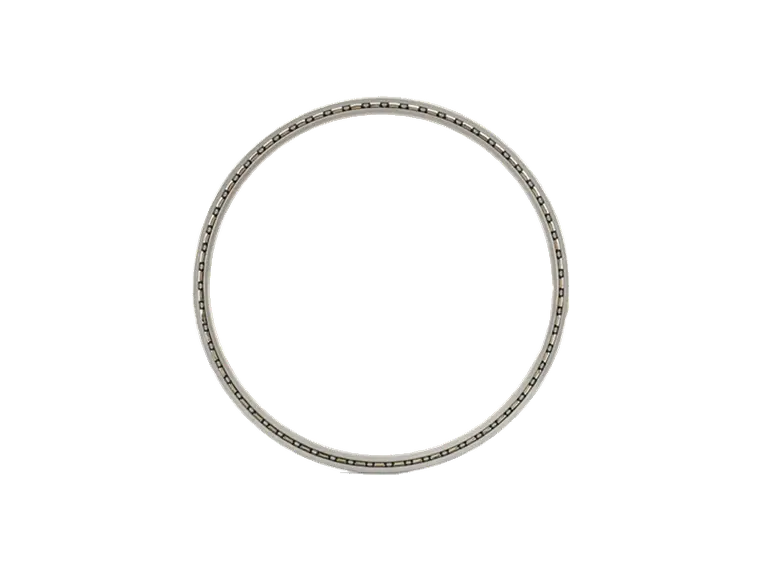
For a given envelope, a crossed roller bearing generally offers substantially higher load capacity and much greater rigidity than a comparable ball bearing. That is not a marketing claim so much as a direct result of contact geometry: the load is spread over more material, and the rolling elements deform less when the load is applied. In practice, designers notice this most in two situations — heavy axial or moment loads, and applications where deflection must stay within a few micrometers.
Ball bearings remain competitive when loads are light and the design priority is low drag, low cost, or high rotational speed. A thin-section ball bearing can be surprisingly capable in a compact space, but it will deflect more under the same moment, and that deflection frequently shows up as lost positioning accuracy at the tool tip or the end effector.
…
For more details on the key differences between crossed roller bearings and ball bearings, please click here: https://www.prsbearings.com/news/crossed-roller-1/


