
Preload and Clearance in Crossed Roller Bearings
Specifying a crossed roller bearing is rarely only a question of bore size and load rating. Two parameters, preload and clearance, determine how the bearing actually behaves once it is installed: how stiff the axis feels, how much torque the drive must overcome, how accurately the load position repeats, and how long the raceways survive. Engineers who understand the difference between a clearance bearing and a preloaded one can match the bearing to the machine instead of compensating for it later with servo tuning and thermal workarounds. This article explains what preload and clearance mean in a crossed roller bearing, how each option affects stiffness, friction, accuracy and life, and how to select and set the right condition for a given application.
What Preload and Clearance Actually Mean
In any rolling bearing, the rolling elements do not fill the space between the raceways perfectly. A small gap exists, and the size of that gap, or the force used to close it, is what engineers call clearance or preload. The two conditions sit at opposite ends of the same scale, and moving along that scale changes nearly every performance characteristic of the bearing.
Clearance: Intentional Play Between Rolling Elements and Raceways
Clearance, also called axial or radial play, is the amount of free movement available in the bearing before the rolling elements contact both raceways under load. In a crossed roller bearing, where cylindrical rollers are arranged at ninety degrees to one another in a single raceway, this play is usually expressed as axial displacement measured with a light gauge load. A bearing supplied with clearance turns freely by hand, generates minimal friction torque, and tolerates small misalignments and thermal expansion without binding. The trade-off is a softer axis: the load has to move through the clearance before the bearing begins to resist, which reduces positioning stiffness and repeatability.
Preload: Removing Play to Create Controlled Elastic Deformation
Preload is the opposite approach. The bearing is assembled or adjusted so that the rolling elements are already pressed against both raceways with a defined force, eliminating free play and creating a small, controlled elastic deformation at the contact points. Because the contact area is already loaded, additional external load meets an immediate, stiffer response. Preload is therefore the standard choice when the goal is high rigidity, precise positioning, or zero measurable backlash in a rotary or linear axis. The cost is higher friction torque, more heat, and a reduced margin for misalignment.
The Standard Preload and Clearance Grades
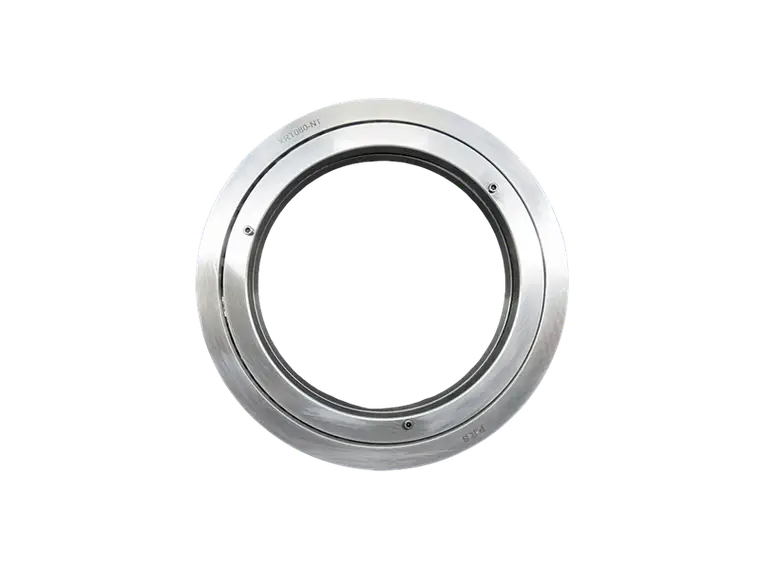
Manufacturers normally classify crossed roller bearings into a small number of preload or clearance grades so that designers can specify a condition rather than a micrometer value. Exact figures vary by size and series, but the categories are consistent across the industry:
- Clearance grade — measurable axial play. Used where friction and heat must stay low and positioning accuracy is not critical.
- Light preload — play eliminated, minimal contact deformation. The usual compromise for general automation and moderate precision.
- Medium preload — higher contact deformation for noticeably greater stiffness. Typical for machine tool indexing tables and precision rotary axes.
- Heavy preload — maximum rigidity for high-frequency, high-accuracy positioning. Requires careful thermal and torque management.
These designations describe an installed condition, not a loose part dimension. A bearing measured on the bench may show play that disappears once the mounting flanges are tightened, which is why the setting method and the housing stiffness matter as much as the grade on the drawing.
…
For more detailed information regarding the preload and clearance of crossed roller bearings, please click here: https://www.prsbearings.com/news/preload-clearance/


