
Crossed Roller Bearings: A Complete Selection Guide
Crossed roller bearings are specified when a machine needs high rigidity, accurate rotation, and a compact envelope — robot joints, machine tool tables, indexing heads, and medical scanners all rely on them. Selecting the wrong configuration, precision grade, or mounting method can degrade positioning accuracy, shorten service life, and inflate cost. This guide explains the structure, the selection parameters that matter, the main design variants, and a step-by-step process engineers can follow to reach a defensible choice.
What Makes a Crossed Roller Bearing Different
A crossed roller bearing has cylindrical rollers arranged at 90° to one another in a single raceway, alternating in sequence along the circumference. Because the rollers cross, one bearing set carries radial, axial, and moment loads simultaneously. That is the core reason designers choose it over a pair of angular contact ball bearings or a conventional thrust-plus-radial combination.
Structural Advantages
- Single bearing replaces multiple load paths, reducing stack height and part count.
- Line contact between roller and raceway produces high stiffness under load.
- Alternating roller orientation limits elastic deformation to a predictable range.
- Preloaded assemblies eliminate internal clearance and improve repeatability.
The trade-off is sensitivity to mounting accuracy and contamination. Crossed roller bearings reward careful design and punish shortcuts in housing preparation.
Key Parameters for Crossed Roller Bearing Selection
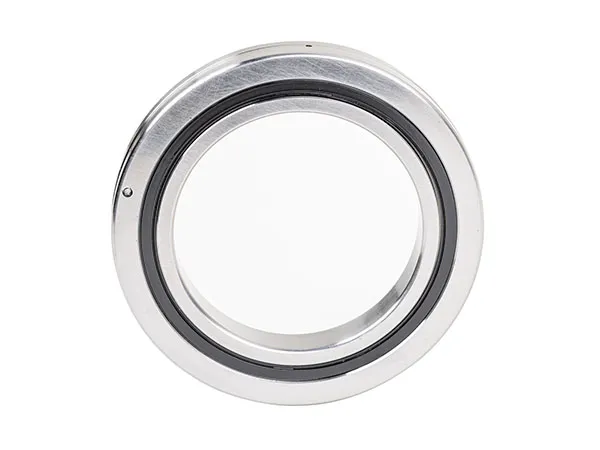
Selection is not a single calculation. It is a sequence of constraints that narrow the field from hundreds of catalog numbers to one or two viable options.
Load Capacity and Moment Rating
Every crossed roller bearing carries three load ratings: dynamic radial, dynamic axial, and moment. A robot arm joint may see a small axial force but a large tilting moment. A rotary table may see heavy axial load with modest moment. The selection process starts by resolving the actual load case — including shock factors and duty cycle — into these three components.
Never size a crossed roller bearing on radial load alone. Moment capacity frequently governs the final choice, especially in cantilevered or offset-load arrangements.
Precision Grade and Rotational Accuracy
Precision grades for crossed roller bearings are typically defined by running accuracy, axial runout, and radial runout. Common tiers map to:
- Standard grade for general indexing and slow rotation.
- High grade for machine tool positioning and metrology.
- Ultra-precision grade for semiconductor equipment and optical stages.
Higher grades cost more and demand tighter mounting surfaces. Specifying ultra-precision on a frame that cannot hold flatness tolerance wastes money.
Envelope, Mounting, and Preload
Crossed roller bearings are available with or without inner and outer mounting holes, in open or sealed configurations, and with different preload classes. A bearing with integral mounting holes simplifies housing design and reduces assembly error. Sealed units retain grease and exclude debris but add drag torque — a factor in high-speed or low-torque applications.
Operating Environment
Temperature range, vacuum exposure, washdown chemicals, and vibration all influence material, lubrication, and sealing choices. Bearings destined for cleanroom use may require vacuum-compatible grease or dry-film lubrication. LYMC supplies crossed roller bearings in configurations matched to these environments, with documentation that supports the selection record.
…
For more information on crossed roller bearings, please click to access the complete selection guide: https://www.mcslewingbearings.com/a/news/crossed-roller-bearings-selection-guide.html


