
Graphite Crucible for Aluminum Melting: Temperature Limits
When melting aluminum, the choice of crucible material directly impacts efficiency, safety, and product quality. Graphite crucibles have long been favored for their exceptional thermal conductivity and resistance to thermal shock, but understanding their temperature limits is critical to avoid premature failure or contamination of the melt. This article examines the maximum operating temperatures for graphite crucibles used in aluminum melting, the factors that influence these limits, and how to select the right crucible for your process. Drawing on industry expertise from Cangzhou Carbon, we provide a professional, data-driven guide for engineers and purchasing managers.
Maximum Operating Temperature of Graphite Crucibles for Aluminum
Graphite crucibles are capable of withstanding temperatures far above the melting point of aluminum (660°C). Standard high-density graphite crucibles typically have a maximum service temperature between 1600°C and 1800°C under inert or reducing atmospheres. However, in air or oxidizing conditions, the practical limit drops to around 800–900°C due to oxidation. For aluminum melting, the crucible rarely needs to exceed 750–800°C, making graphite a safe and reliable choice—provided the crucible is properly rated and maintained.
Why Temperature Limits Matter in Aluminum Melting
Although aluminum melts at a relatively low temperature, overheating the crucible can accelerate oxidation, reduce crucible life, and introduce impurities. Crucibles from Cangzhou Carbon are manufactured with a controlled porosity and ceramic coating that enhances oxidation resistance, allowing sustained use at temperatures up to 850°C without significant degradation. Exceeding the recommended limit can cause cracking, spalling, or catastrophic failure.
Factors That Influence Graphite Crucible Temperature Limits
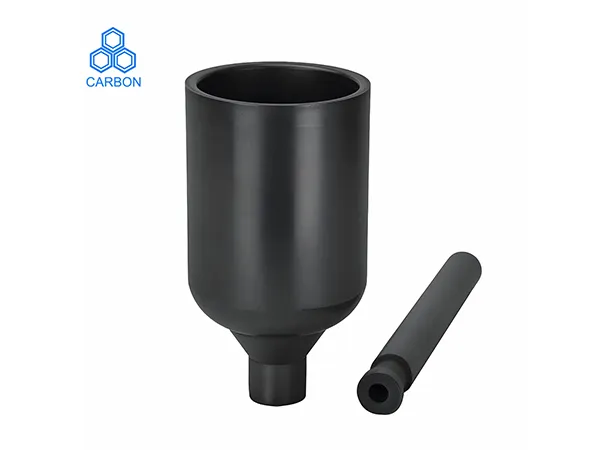
Not all graphite crucibles are equal. The effective temperature limit depends on several material and design parameters:
- Graphite Grade and Density: Higher-density graphite (≥1.75 g/cm³) offers better oxidation resistance and thermal shock performance. Low-density grades may begin to erode above 700°C.
- Coating and Impregnation: Crucibles with a silicon carbide (SiC) or ceramic glaze coating can withstand higher surface temperatures and reduce oxygen penetration. Cangzhou Carbon applies a proprietary dual-layer coating that extends the safe operating range by up to 100°C.
- Atmosphere: Under protective gas (argon, nitrogen), graphite can survive above 2000°C. In open air, oxidation becomes the limiting factor beyond 500°C.
- Flux and Slag: Alkaline fluxes used in aluminum refining can attack the graphite matrix, accelerating wear and effectively lowering the temperature ceiling.
Therefore, for aluminum melting in ambient air, the practical temperature limit of a standard uncoated graphite crucible is approximately 800°C. Upgrading to a Cangzhou Carbon coated crucible raises that limit to 900°C, providing a safety margin for superheat or alloying operations.
…
For more information regarding graphite crucibles used in aluminum melting—including details on temperature limits—please click here: https://www.czgraphite.com/a/news/graphite-crucible-for-aluminum-melting.html


