
How to Train Staff on a New Glass Cutter Safely
Introducing a new glass cutter to your workshop is a significant investment in productivity. However, even the most advanced machinery can become a liability if operators lack safe handling skills. A structured training program not only prevents serious injuries but also reduces material waste, downtime, and inconsistent cut quality. DISAI has spent years observing successful glass fabrication plants and has refined a training philosophy built on clarity and hands-on supervision. The following framework will help you bring your team up to speed without compromising their safety or morale.
Why Systematic Safety Training Is Mandatory for Glass Cutting
Glass cutting remains one of the more dangerous processes in glass fabrication. Sharp shards, high-speed scoring wheels, heavy glass sheets, and moving conveyors create a combination of hazards that plain intuition cannot solve. Relying on informal buddy training
often leads to inconsistent habits and silent mistakes. A systematic training program ensures every operator learns not only the controls but the reasoning behind each safety rule. When staff understand why certain actions are forbidden, they are far more likely to follow them under stress. Moreover, occupational safety inspectors are increasingly demanding documented proof of training. Without it, your company becomes exposed to legal claims and operational fines.
A Step-by-Step Safety Training Framework for Your New Glass Cutter
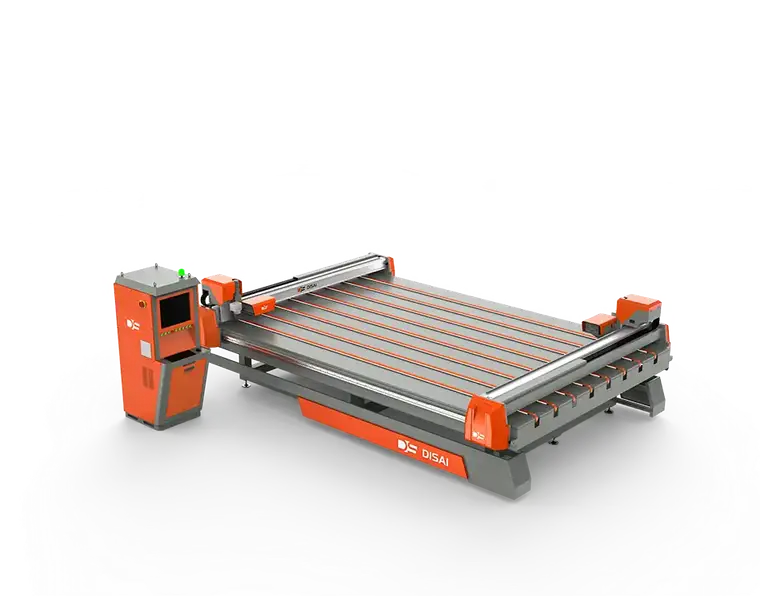
Effective training does not happen in a single afternoon. It requires a planned progression from theoretical understanding to supervised practice. Below is a proven structure that works for manual, semi-automatic, and fully automatic DISAI cutters.
Step 1: Pre-Training Risk Assessment
Before any trainee touches the machine, evaluate their existing experience and physical readiness. Review the specific hazards present in your workstation: sharp edges, airborne glass dust, noise levels, and manual handling risks. Provide properly fitting PPE, including cut-resistant gloves, safety glasses, steel-toe boots, and hearing protection. Map out a clear training path for each individual based on their prior knowledge. This step also includes a walk-through of emergency exits and first-aid kits so that operators know the bigger safety picture.
Step 2: Machine Familiarization and Built-In Safety Mechanisms
Introduce the exact model of DISAI glass cutter your company uses. Show the main power switch, the emergency stop buttons (fixed on both sides of the frame), and the control panel. Explain the pressure control for the scoring wheel and the need to set it according to glass thickness. Teach the operator how to inspect the cutting wheel for wear and how to replace it without coming into contact with the breaking edge. Emphasize that every guard and sensor has a purpose; removing them for convenience is the most common root cause of workshop accidents.
…
For more detailed information on how to safely train employees to use the new type of glass cutter, please click here: https://www.disaiglass.com/industry-news/glass-cutter-guide-2/

