
Which Cutting Head Is Best for Curved Glass Design?
The rapid expansion of curved glass in architectural facades, automotive glazing, and premium interior products has created a new set of challenges for glass fabricators. Cutting a straight line is no longer sufficient for many projects. Curved designs demand a cutting head that can maintain precise scoring pressure while continuously changing direction, and that choice directly controls edge quality, breakage rate, and final production cost. This article compares the leading cutting head technologies available for curved glass design, examines how each performs under real production conditions, and explains the engineering logic behind selecting the right one, with practical reference to DISAI’s solutions.
The Unique Demands of Curved Glass Cutting
Curved glass includes bent-tempered panels, curved laminated units, automotive sidelites, and custom-shaped shower enclosures. These products share one common challenge: the cutting head must follow a non-linear path while keeping the scoring wheel perpendicular to the direction of travel. On a straight cut, force distribution is constant and predictable. On a curve, the head experiences lateral forces that change at every point of the arc.
If the cutting head has any mechanical play, or if the pressure control system reacts too slowly, the score line becomes inconsistent. The result is micro-cracks that are invisible immediately after cutting but develop into visible chips after edge grinding, or into full breakage inside the tempering furnace. This is why the cutting head, rather than the glass itself, is often the real limiting factor in curved glass operations.
Main Cutting Head Technologies Compared
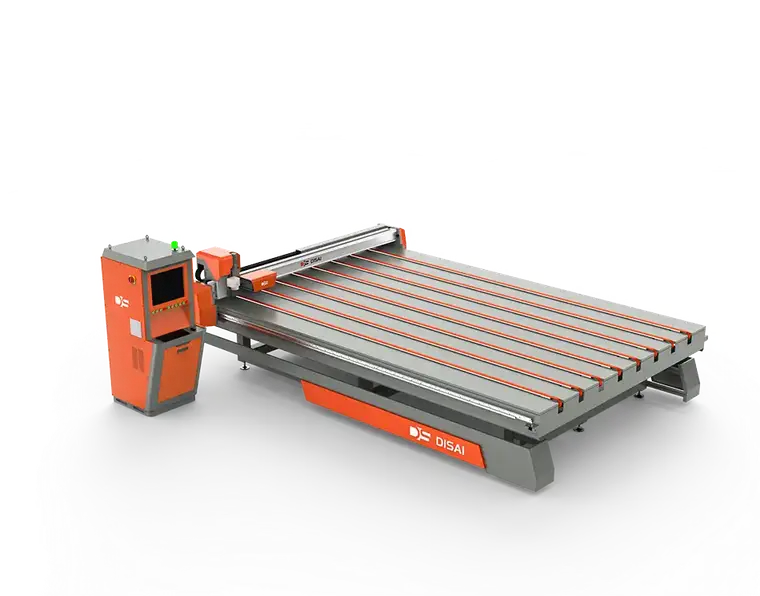
Carbide Scoring Wheels
Carbide wheels are the workhorse of the glass cutting industry. They create a clean fracture line by applying carefully controlled pressure along the glass surface. For curved glass with generous radii, a standard carbide wheel can deliver acceptable results at moderate speeds. The wheel’s simple geometry also makes it inexpensive to replace and easy to maintain.
The limitation appears when the curve radius becomes tight. The contact patch between the wheel and the glass changes shape, causing under-scoring on the inner side of the curve and over-scoring on the outer side. This uneven fracture leads to edge chipping and reduced bending strength, which becomes a serious issue in tempered products where residual stress is high.
Diamond Impregnated Heads
Diamond heads are often mentioned in discussions about curved glass, but their proper role is grinding and edge finishing rather than scribing. A diamond-impregnated head removes material mechanically, which makes it suitable for thick glass over 12 mm and for shaping hardened edges. However, because diamond cutting generates heat, it can induce thermal stress in thin glass and is slower than a scoring approach for mass production.
…
Click here for more detailed information on which cutting head is best suited for curved glass designs: https://www.disaiglass.com/industry-news/cutting-head-guide/

