
High-Speed Roller Bearings: Design Limits Explained
Roller bearings carry heavier loads than ball bearings of the same envelope, but that advantage comes with a speed penalty. As rotational speed rises, rollers gain centrifugal force, internal load paths shift, and the heat generated inside the bearing begins to outrun the heat it can shed. At some point the bearing stops behaving like a load-carrying component and starts behaving like a thermal and dynamic problem. Knowing where that point sits, and which design variables move it, is what separates a reliable high-speed arrangement from one that fails early. This article explains the physical limits behind roller bearing speed ratings and the design decisions that raise them.
What a Speed Rating Really Tells You
Bearing catalogs publish two different numbers, and confusing them is one of the most common specification errors. The limiting speed is a catalog-level ceiling for a given bearing under defined reference conditions, typically light load, correct lubrication, and adequate heat dissipation. The thermal reference speed, defined in ISO 15312, is derived from a heat balance: the speed at which heat generation inside the bearing equals heat dissipation through a defined housing and shaft, for a stated reference temperature rise.
Neither figure is a guarantee. Both assume favorable conditions that a real application rarely reproduces exactly. A roller bearing rated at one speed in a catalog may run far below that rating inside a poorly cooled, heavily preloaded housing, or comfortably above it when oil-jet lubrication and a rigid, thermally stable shaft are in place.
The Physical Limits Behind the Numbers
Heat generation versus heat dissipation
Every high-speed bearing is a heat engine in a losing battle with itself. Friction torque comes from rolling resistance, sliding in the contacts, lubricant churning, and cage interaction. That heat must travel out through the rollers, rings, shaft, and housing. As speed climbs, heat generation rises faster than most conduction paths can carry heat away, and the lubricant film that keeps metal off metal thins as temperature increases.
The practical result is a runaway threshold. Beyond a certain speed, each increment of friction produces more heat, which reduces film thickness, which increases friction. Once that loop begins, bearing life collapses quickly. This is why temperature, not rotational speed, is usually the true limiting variable.
Centrifugal and gyroscopic effects on the rollers
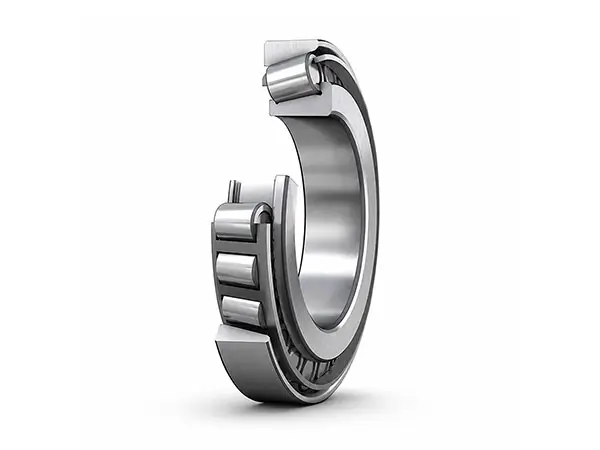
A cylindrical or tapered roller orbiting a shaft at high speed experiences centrifugal force proportional to the square of rotational speed. At moderate speeds this force is negligible. At high speeds it presses the roller against the outer raceway, alters the load distribution around the bearing, and can cause the roller to skew within its pocket. For spherical and tapered rollers, the effect is more pronounced because of greater mass and more complex geometry.
The consequence is a bearing that carries its rated load at low speed but loses effective capacity as speed rises. Nothing about the steel has changed; the internal load path has.
…
For more detailed information on high-speed roller bearings—including an in-depth look at design limits—please click here: https://www.chgbearingtech.com/blog/roller-bearing-rpm/


