
High Temp Test Equipment for Fire Resistance Testing of Materials
When evaluating the fire safety of construction materials, aerospace composites, or electrical insulation, precise high-temperature testing is non-negotiable. The ability to simulate extreme thermal conditions and measure a material’s response—ignition time, flame spread, heat release, and structural integrity under direct fire exposure—directly impacts certification, building code compliance, and product liability. For engineers and quality managers, selecting the right high temp test equipment for fire resistance testing of materials requires a deep understanding of test standards, temperature uniformity, data acquisition accuracy, and long-term reliability. This article provides a technical overview of the critical factors and showcases how HEATEST Instrument’s equipment meets the rigorous demands of modern fire testing laboratories.
Understanding High Temperature Test Equipment for Fire Resistance
High temperature test equipment for fire resistance testing encompasses furnaces, radiant panels, cone calorimeters, and vertical/horizontal flame chambers designed to expose materials to controlled thermal environments—often exceeding 1000°C. The primary objective is to replicate real-fire scenarios while measuring parameters such as heat flux, mass loss, smoke density, and time to ignition.
Core Types of Fire Resistance Testing Equipment
- Furnace Systems: Used for wall, floor, and column assemblies per ASTM E119, ISO 834, or EN 1363. These units must maintain precise temperature curves (e.g., standard time-temperature curve) with deviation under ±10°C.
- Cone Calorimeters: Based on ISO 5660, they measure heat release rate (HRR) via oxygen consumption calorimetry, critical for assessing flammability of upholstery, plastics, and building finishes.
- Radiant Panel Systems: For floor coverings (ASTM E648) and textiles, these apply a controlled radiant heat flux to determine critical radiant flux (CRF).
- Vertical/Horizontal Flame Chambers: UL 94, IEC 60695, and ASTM D3801 classify materials as V-0, V-1, etc., based on flame propagation after exposure to a defined flame source.
Critical Performance Requirements for Reliable Test Results
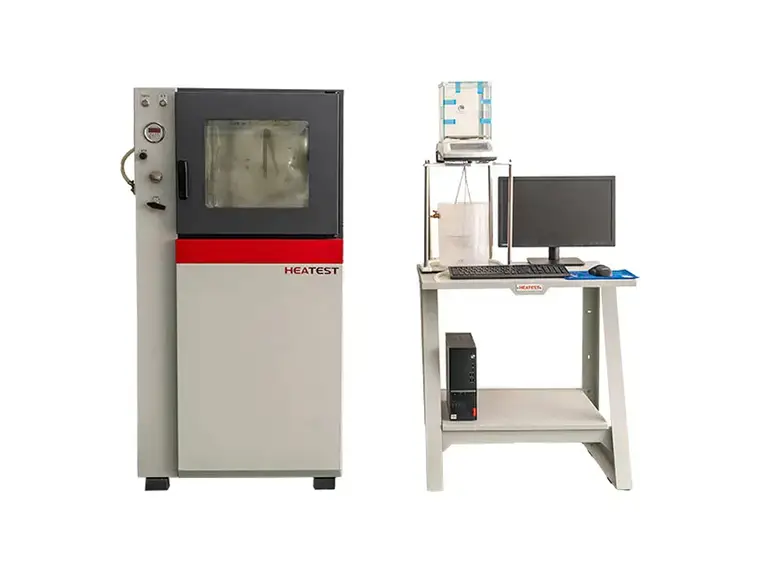
Accuracy, repeatability, and durability are non-negotiable in fire testing. The following parameters must be carefully evaluated when specifying high temp test equipment:
Temperature Uniformity and Ramp Rate
ISO & ASTM standards mandate that furnace temperatures across specified measurement points differ by no more than a defined tolerance (e.g., ±10°C at 1000°C). A poorly insulated or unevenly heated chamber leads to invalid test results and wasted test cycles. HEATEST Instrument manufactures furnaces with multi-zone PID control and helically wound heating elements to achieve class-leading uniformity.
…
For more detailed information on high-temperature testing equipment used for evaluating the fire resistance of materials, please click here: https://www.lyheatest.com/tester-knowledge/high-temp-fire-test/


