
Thin-Section Bearings: The Secret to Lightweight Gimbal Systems
Gimbal systems used in drones, camera stabilization, robotics, and precision instrumentation face a relentless demand for weight reduction without compromising load capacity or rotational accuracy. Every gram saved translates directly to longer flight times, smoother motion, or smaller actuator requirements. The component often overlooked in this pursuit is the bearing. Conventional bearings, with their relatively thick cross-sections, impose unnecessary bulk. This is where thin-section bearings emerge as a transformative solution. Their reduced radial and axial dimensions allow designers to drastically cut weight while maintaining or even improving performance. For engineers seeking the optimal balance between compactness and reliability, understanding the engineering behind thin-section bearings—and why a specialist supplier like BIBO Bearing matters—is essential.
What Are Thin-Section Bearings?
Thin-section bearings are a class of rolling bearings characterized by a significantly reduced cross-section relative to their bore diameter. Unlike standard bearings that have a proportional relationship between bore size and cross-sectional thickness, thin-section bearings maintain a thin, uniform cross-section across a wide range of bore diameters—from as small as 25 mm up to several meters. This is achieved through optimized raceway geometry, specialized steel or ceramic materials, and precision manufacturing processes.
Key Geometric Feature
The defining parameter is the cross-section ratio: the thickness of the bearing ring (radial and axial) is typically only 10% to 20% of the bearing bore diameter. For example, a 100 mm bore thin-section bearing might have a radial thickness of just 10–12 mm, whereas a standard deep-groove ball bearing of the same bore would be about 24 mm thick. This difference is what unlocks substantial weight savings—often 50% or more compared to conventional bearings of equivalent load rating.
Why Thin-Section Bearings Are the Secret to Lightweight Gimbals
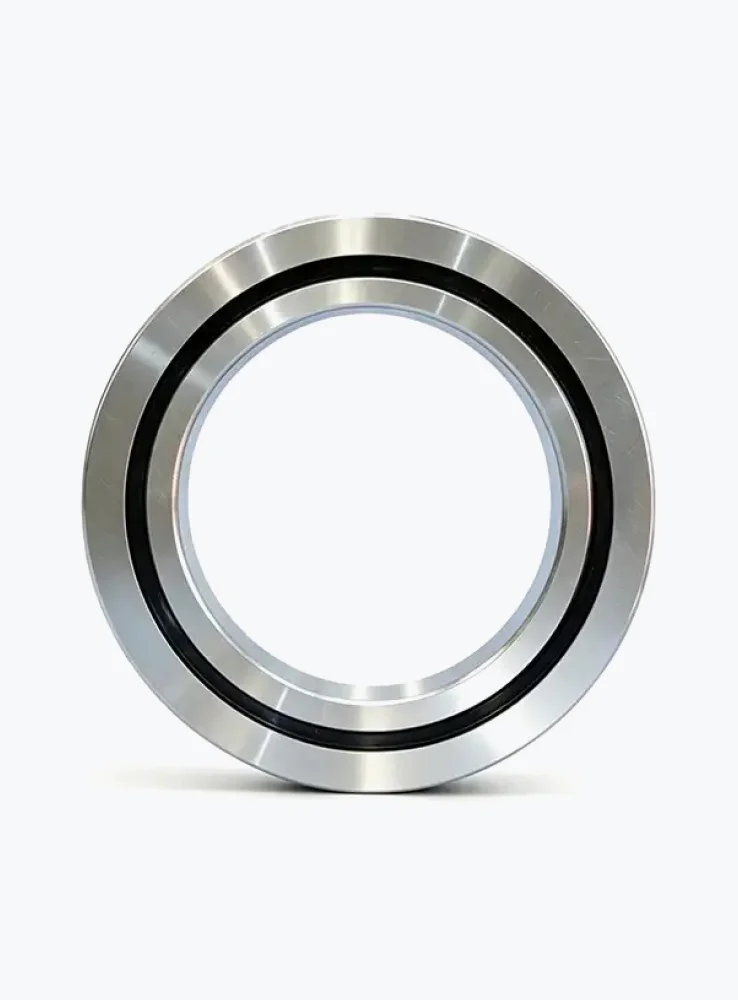
Gimbal systems require bearings that can handle combined axial and radial loads, maintain low starting and running torque, and fit within tight spatial envelopes—all while contributing minimal inertia to the moving assembly. Thin-section bearings satisfy every one of these demands exceptionally well.
Weight Reduction Without Sacrificing Capacity
A typical gimbal bearing operates under relatively low loads but must support the weight of the payload (camera, sensor, etc.) and resist occasional shock loads. Thin-section bearings are engineered with optimized raceway curvatures and ball complements that achieve load ratings comparable to much larger standard bearings. By eliminating excess ring material, the bearing weight is reduced dramatically—a critical advantage for battery-powered flying or handheld stabilization.
Space Savings and Compact Design
The slender cross-section of thin-section bearings allows gimbal designers to reduce the outer diameter of the bearing housing and the inner diameter of the shaft, shrinking the overall envelope. This enables tighter packaging of motors, encoders, and control electronics, which further reduces system weight and rotational inertia. In multi-axis gimbals, the accumulated savings across all axles can represent 15–30% of the total gimbal weight.
…
For more detailed information about thin-section bearings: the secrets of lightweight gimbal systems, please click to visit: https://www.bobibearing.com/a/bearing-knowledge/thin-section-bearings.html


